

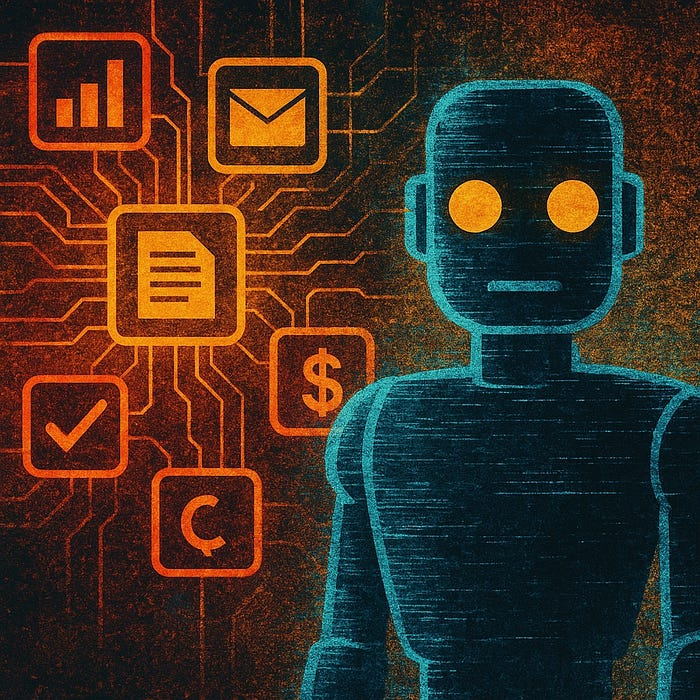
There’s a growing acceptance among the world’s largest technology corporations that SaaS (Software as a Service), the cornerstone of decades of digital transformation, is going to be replaced by AI agentic systems. I discussed this recently in the wake of the news that Klarna was replacing its data management software with agents, LLMs and AI. Now, Microsoft CEO Satya Nadella has predicted the “collapse” of SaaS in the bluntest of terms. I have to say, from my perspective as somebody who is working on the development of a cutting-edge agentic system, that sounds like good news.
Nevertheless, it’s worth stopping to think what this change consists of, the threats it poses to traditional software, and whether this collapse is inevitable or simply something we already knew. The basic idea is that AI agents, models capable of planning, reasoning, executing connected multiple tasks, learning as they go, coordinating between subsystems, are way beyond software as a tool. Instead of requiring humans to interact with multiple applications to run a workflow, these agents can internally orchestrate those applications, decide what to, when and how, ideally with minimal disruption or oversight.
The threats to conventional SaaS, and the companies that sell it, come not only from the possibility of losing their market share, but from a redefinition of what “software service” entails: license-based pricing, subscriptions per user or per interface use, rigid modulation of workflows, permanent need for manual integration and fragmentation of functions between multiple applications. All of these go away when autonomous AI comes into the picture, able to get the job done rather than just help with it.
At this point, we’re still not talking about something able to replace everything. There are technological, organizational and value barriers that prevent immediate substitution. Many agents still aren’t reliable or accurate enough, and lack the domain understanding to perform complex tasks unsupervised; among the issues are security and error risks, drift (when the agent deviates from its objective), along with governance, transparency and monitoring of regulatory compliance. Gartner estimates that more than 40% of agentic projects will be abandoned by 2027 because of these problems.
There will be certainly be problems down the line, but the question is whether businesses will stick with the model; whether most corporate information systems such as ERPs, CRMs, collaboration platforms, advanced analytics, etc. will now evolve towards architectures focused on autonomous agents. I believe what’s coming is a three-layered transformation. First, the data layer or systems of record: historical repositories, databases, sensors, archives. That layer will continue to exist, and its integrity will remain crucial. Second is the agency layer or AI agent operating system. This is where the agents are housed, and use the data, execute logic, learn and make decisions. Third is the results interface, by which users perceive the final result: not necessarily as a traditional application with menus, screens and user paths, but as results already executed: a report, an action accomplished, a task completed.
Today’s SaaS lives in the intermediate layer + interface: it handles flows and integrations, but on the premise that the user activates, selects or controls. AI agents try to take over some of that active control, automate, decide, and adapt. For companies, this means changing what they value: not how much the license costs per user, but how much value the agent produces; not how long a user has been navigating the interface, but how much time is saved; not how many different apps are integrated, but how many agents can be coordinated to solve a complex problem.
But among the disruption there will be reconfigurations and opportunities. Incumbent SaaS companies that understand this will be able to adapt, migrate to AI-first models, rethink their value propositions, perhaps change pricing structures towards results or objectives achieved, not just by functions used. Competitive advantages will come from those who control the data, who have the ability to label, train, specialize agents and who guarantee security, transparency, auditing and explainability.
Businesses will also have to take transition costs into account: migrating rigid architectures and integrating agents will require new protocols, standards, governing machines, dealing with failures, biases, drift and exposure to as yet unknown vulnerabilities. Not all agents will function as good agents: some will behave badly, deliberately or by accident. The risks are not just technical, but organizational, ethical and legal.
Perhaps the most interesting thing about all this is not so much which specific technologies succeed, but what ethical, economic and power questions this transition may raise: who designs the objectives of the agents? Who guarantees that they act in accordance with the interests of the customer, not only what maximizes economic or usage metrics? What institutions will regulate these systems? How are the costs and benefits shared? What happens to those who do not have the resources to train agents?
Because if the agency model succeeds, it will not only be a technological revolution, it will redefine how we work, how information is organized in companies, how we measure productivity and value. And as in all technological revolutions, there will be winners and losers, not only among companies, but of economic models, organizational cultures and institutional structures.
SaaS may not be dead yet, but it could be mortally wounded. And SaaS providers’ survival will depend on their ability to anticipate, adapt and govern autonomous agents: because whether they like it or not, it seems they’re here to stay.