

Great content earns attention; SEO optimized content earns rankings, clicks, and revenue.
SEO writing blends two disciplines: useful information for humans and clear signals for search engines. That means smart keyword selection, intent-matched structure, compelling titles and meta descriptions, and content that actually solves the searcher’s problem.
This guide walks you through a practical, end-to-end process—from keyword discovery to final polish—and gives you a 25-point checklist you can run on every SEO Optimized articles to ship with confidence.
What “SEO-Optimized Writing” Really Means
SEO writing is reader-first content arranged in a way that search engines can understand and rank. Done right, it increases:
- Visibility: more qualified impressions for relevant queries
- Engagement: better readability, dwell time, and scroll depth
- Conversions: tighter alignment between user intent and your offer
Forget keyword stuffing. Modern SEO favors clarity, coverage, and credibility—plus technical signals that help machines parse meaning.
The 4-Step SEO Writing Process
Writing a powerful, SEO-optimized article isn’t about chasing algorithms — it’s about creating content that aligns with what users are searching for and how search engines interpret relevance and value.
This process unfolds in four structured steps, each designed to help your article rank, retain, and convert.
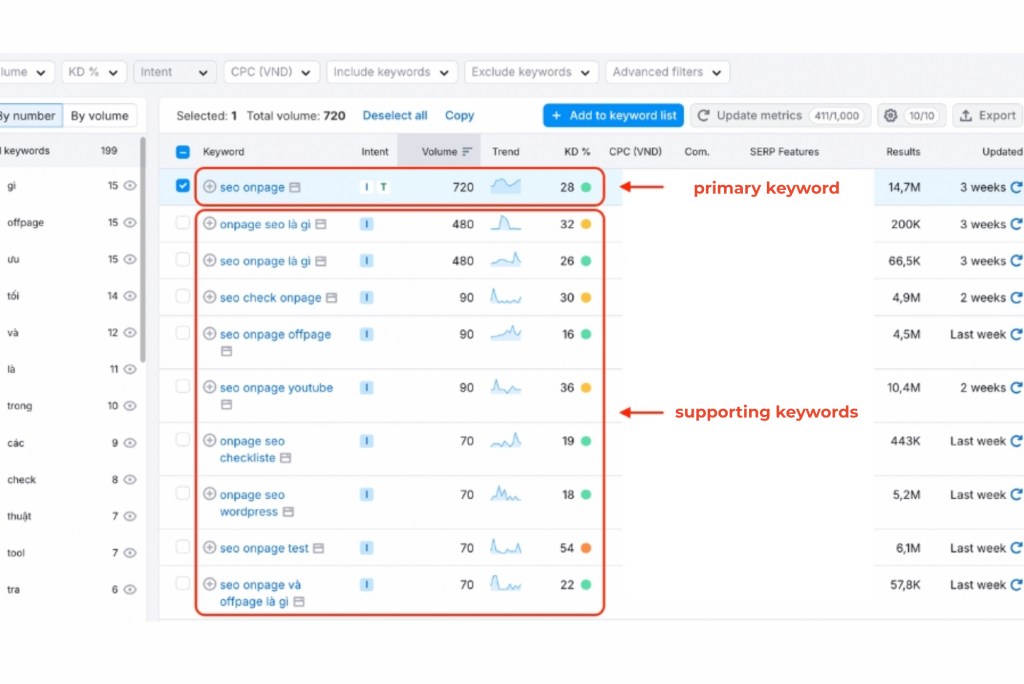
Step 1 — Identify Primary & Secondary Keywords
Keyword research is the foundation of SEO writing. It determines not only what you write, but how you frame your message to meet user intent.
Start by choosing one primary keyword (the central focus of your article) and several secondary or supporting keywords (variations, synonyms, or long-tail phrases that reinforce the main topic).
How to Find the Right Keywords
Use reliable tools such as:
- Google Keyword Planner – to gauge search volume and competition.
- Ahrefs or SEMrush – to uncover keyword gaps, analyze competitors, and find long-tail opportunities.
- Ubersuggest or AnswerThePublic – to collect related questions and trending subtopics.
What to Evaluate
When selecting your keywords, analyze three key factors:
- Search Volume: Choose terms with enough volume to bring in measurable traffic.
- Keyword Difficulty (KD): Balance ambition and feasibility. A new site should prioritize lower-difficulty, long-tail phrases.
- Relevance: Every keyword must align naturally with your content’s goal, audience, and offer.
Keyword Classification
- Primary Keyword: A short, high-volume phrase directly tied to your main topic. Example: SEO content writing.
- Secondary Keywords: Variations, modifiers, or related long-tails that expand semantic reach. Example: how to write SEO articles, SEO writing checklist, content optimization tips.
Pro Tip:
Mix high-competition head terms with low-competition long-tails.
This combination lets you gain traction quickly while building authority for bigger targets later.
Step 2 — Analyze Search Intent
Even the perfect keyword fails if you misunderstand why people are searching for it.
Every Google query carries a purpose — and matching that purpose is the difference between visibility and irrelevance.
The Four Types of Search Intent
- Informational: The user wants to learn or understand something.
Example: “How to write SEO-friendly articles.” - Navigational: The user wants to find a specific site or page.
Example: “Yoast SEO login” or “Google Search Console.” - Transactional: The user intends to buy or take action.
Example: “Buy Ahrefs subscription” or “Sign up for Grammarly Premium.” - Commercial Investigation: The user is comparing options before making a decision.
Example: “SEMrush vs Ahrefs review” or “best SEO tools for small businesses.”
How to Determine Intent
- Search your keyword on Google: Observe what types of pages are ranking — guides, reviews, product pages, videos, etc.
- Study SERP features: Check for Featured Snippets, People Also Ask boxes, or product carousels. They reveal what users expect.
- Read the top 5–10 results: Note how they structure information, tone, and depth.
If you see guides ranking, users likely want education.
If you see product pages, they’re ready to act or buy.
Aligning Content to Intent
Once you understand the dominant intent:
- Create educational, in-depth content for informational queries.
- Focus on comparisons, benefits, and CTAs for commercial or transactional terms.
- Include internal links to relevant products, case studies, or lead magnets where appropriate.
Matching intent builds trust, improves dwell time, and signals Google that your content deserves a higher ranking.
Step 3 — Build an SEO-Friendly Outline
A strong outline is like a blueprint for clarity and flow. It helps both readers and search engines navigate your content smoothly.
Before writing a single word, map your article structure to balance logic, engagement, and keyword placement.
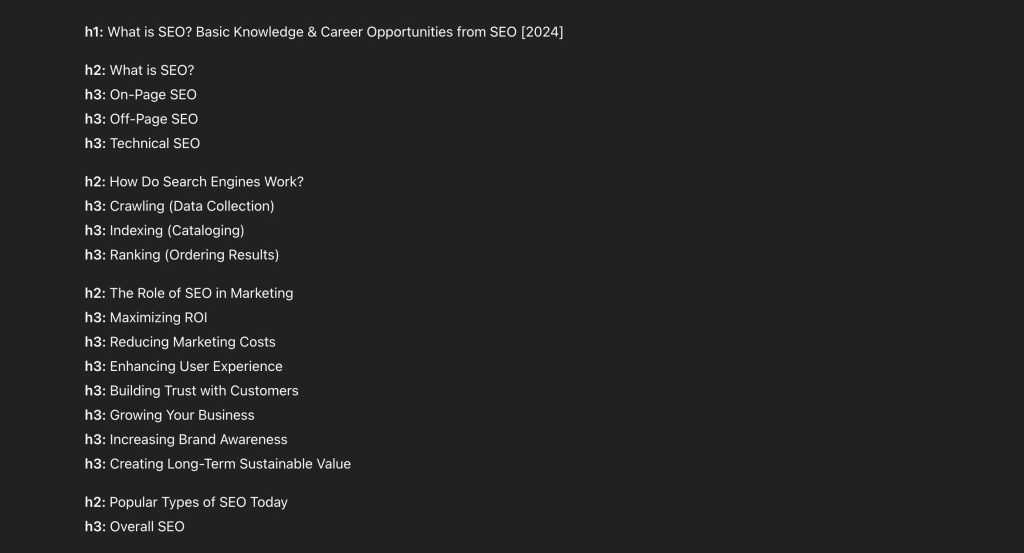
Structure Your Outline
- Main Title (H1):
- Must include the primary keyword.
- Should be concise, descriptive, and engaging.
- Example: How to Write SEO-Optimized Articles in 2025 (Step-by-Step Guide)
- Main Sections (H2):
Divide your article into 3–5 key sections, each addressing a unique aspect of the topic.
Example for this article:- Step 1: Keyword Research
- Step 2: Search Intent
- Step 3: Outline Creation
- Step 4: Content Writing & Optimization
- Subsections (H3 & H4):
Break complex topics into smaller parts for readability — such as lists, examples, and definitions.
Organize Logically
- Start broad, then go narrow.
- Place the most important information at the top (inverted pyramid technique).
- Ensure each section connects naturally to the next.
Keyword Integration
- Use the primary keyword in H1 and at least one H2.
- Place secondary keywords in H3s and within the text organically.
- Avoid mechanical repetition — focus on semantic variations (Google’s NLP will connect them).
Why This Step Matters
A clean structure helps:
- Readers scan easily (especially on mobile).
- Google’s crawlers identify hierarchy and context faster.
- Your article appear in Featured Snippets or AI Overviews due to its logical, scannable format.
Step 4 — Write & Optimize Your Content
Now comes the execution phase — transforming research and structure into a high-performing, reader-first article.
Focus on Quality
Quality is more than grammar. It’s about usefulness, depth, and trustworthiness.
- Write unique insights, not generic summaries.
- Provide data, case studies, or examples when possible.
- Use natural, conversational language that matches your audience’s familiarity level.
Keyword Optimization (Without Stuffing)
- Mention the primary keyword once in the opening paragraph and once in the conclusion.
- Sprinkle secondary and LSI keywords throughout — but keep it natural.
- Replace repetition with synonyms and related terms (semantic SEO).
Formatting for Readability
- Keep paragraphs short (2–4 sentences).
- Use bullet points, numbered lists, and bold text for key takeaways.
- Add visuals — screenshots, infographics, short videos — to break text monotony.
Technical Optimization
- Meta Title & Description:
- Title ≤ 60 characters; meta ≤ 160 characters.
- Include primary keyword and emotional trigger (e.g., “Step-by-Step,” “Checklist,” “Guide”).
- URL Structure:
- Keep it short, descriptive, and keyword-rich.
- Example:
https://10xai.top/how-to-write-seo-articles
- Images:
- Add descriptive alt text (with keywords where appropriate).
- Compress to maintain fast page speed.
- Internal & External Links:
- Add internal links to related posts (e.g., SEO Tools 2025, AI Content Strategy).
- Add external links to authoritative sources (Google, HubSpot, Ahrefs, etc.).
- Schema Markup:
- Implement FAQ schema or How-To schema for better SERP visibility.
Final Review
Before publishing, recheck everything:
- Run Grammarly and Hemingway for style and clarity.
- Test loading speed on Google PageSpeed Insights.
- Use Yoast or RankMath to verify keyword density, metadata, and readability.
The 25-Point SEO Content Checklist (2025 Edition)
A well-optimized article isn’t just about keywords — it’s a symphony of structure, semantics, and storytelling.
Use this 25-step checklist as your Content Quality Control System before every publication.
It’s divided into three stages:
- While Writing (1–10) – Foundation of quality and structure.
- After Drafting (11–20) – Optimization and technical refinement.
- Advanced SEO Optimization (21–25) – To rank higher and convert better.
Phase A — While Writing (1–10)
Focus on content quality, clarity, and fundamental SEO elements.
1. Ensure Original, Unique Content
Originality is non-negotiable. Duplicate or spun content kills trust — for both readers and Google.
Use Copyscape, Grammarly’s plagiarism checker, or Quetext to confirm authenticity.
Even partial duplication can hurt rankings and authority.
Pro tip: Add your own perspective, examples, or case studies. Google’s E-E-A-T (Experience–Expertise–Authoritativeness–Trustworthiness) favors real-world insight.
2. Eliminate Grammar & Spelling Errors
A flawless article communicates credibility.
Check your writing using Grammarly, ProWritingAid, or Hemingway App.
Avoid jargon overload. Write like you’re teaching — not preaching.
Clear writing = clear thinking. And clear thinking earns backlinks.
3. Use Proper Content Formatting
Formatting guides readers and search engines through your content.
- Bullet points: For lists, benefits, or step-by-step guides.
- Tables: For comparisons or data.
- Short paragraphs: 2–4 sentences max.
- Headings (H1–H4): For hierarchy and scannability.
Structured formatting = longer dwell time + lower bounce rate.
4. Include Relevant Images or Videos
Visuals make your article memorable and sharable.
- Choose relevant, high-resolution images or short clips.
- Compress files (TinyPNG, Squoosh) to maintain site speed.
- Add captions when needed.
- Always include alt text (see checklist item #16).
Articles with visuals get 94% more views than text-only posts.
5. Include the Primary Keyword in the Title
The title is your first impression on both searchers and Google.
It must contain your primary keyword near the beginning (within the first 2–3 words if possible).
Keep it between 55–65 characters for best SERP display.
✅ Example:
Instead of “SEO Tips for Beginners”, try “10 Actionable SEO Tips for Beginners (2025 Guide)” — clear, keyword-rich, and curiosity-driven.
6. Add Secondary Keywords in Headings (H2, H3)
Headings signal topical relevance.
Include secondary or long-tail keywords naturally across your H2s and H3s.
This helps Google understand your article’s scope and strengthens semantic depth.
7. Write a Compelling Meta Description (With Keywords)
Your meta description is the elevator pitch that drives clicks.
- Keep it 150–160 characters.
- Include the primary keyword near the start and one secondary keyword mid-sentence.
- End with a call-to-action (CTA).
✅ Example:
“Learn how to write SEO-friendly articles with our 25-point checklist. Boost rankings, clicks, and conversions — start optimizing today!”
8. Include the Primary Keyword in the Introduction & Conclusion
Search engines prioritize early signals.
Mention your primary keyword once in the intro paragraph and once in the final section.
This reinforces your topic without stuffing.
9. Match Content Length to Search Intent
Longer isn’t always better — relevance is.
That said, detailed articles (1,500–2,000+ words) tend to perform better for competitive terms.
How to find your sweet spot:
- Analyze the average word count of top-ranking pages.
- Ensure completeness: cover every question and subtopic users might have.
- Avoid fluff — depth beats length.
10. Optimize Readability for Humans & Mobile User
Readability affects bounce rate, session time, and SEO signals.
- Use clear fonts (≥16px).
- Maintain ample white space.
- Write short sentences and short paragraphs.
- Use transitional words (“however,” “therefore,” “in addition”) for flow.
- Test readability with Hemingway App or Yoast SEO’s score.
Phase B — After Drafting (11–20)
Now that the draft is complete, shift to optimization and fine-tuning.
11. Use Bold/Italic Formatting Strategically
Formatting emphasizes hierarchy and key takeaways.
- Bold important phrases or keywords once or twice per section.
- Italicize for definitions, examples, or quotes.
- Avoid underlines — they can confuse readers with hyperlinks.
Consistency is key; don’t overdo it.
12. Optimize Blockquotes for Trust and Engagement
Blockquotes draw attention to authoritative insights or data.
Use them for expert quotes, statistics, or industry definitions.
- Keep them short and impactful.
- Always cite the source.
- Style them elegantly with CSS (no heavy borders or italics overuse).
Example:
“Content that answers real user questions is the foundation of modern SEO.” — Neil Patel
13. Add Internal Links to Related Pages
Internal linking is your SEO flywheel.
It distributes link equity and helps Google understand topic clusters.
- Use descriptive anchor text (e.g., “SEO Content Framework” instead of “click here”).
- Link to pillar pages, related guides, or product pages.
- Limit to 3–7 internal links per 1,000 words.
14. Add External Links to Authoritative Sources
External links show Google that you’re connected to credible information.
- Link only to reputable sites (Google, HubSpot, Moz, etc.).
- Keep anchor text descriptive.
- Set links to open in a new tab (
target="_blank"). - Avoid linking to direct competitors.
15. Optimize the Featured Image / Thumbnail
Your thumbnail is your “visual headline.”
It affects CTR on both Google Images and social media.
- Use a 1200×630px image (ideal for Facebook/Twitter previews).
- Add your title or keyword phrase as text overlay.
- Keep file names descriptive:
seo-writing-checklist-2025.jpg. - Compress for speed (<200KB preferred).
16. Add Descriptive Alt Text for Every Image
Alt text serves both accessibility and SEO.
- Describe exactly what’s in the image.
- Include keywords naturally (not mechanically).
- Stay under 125 characters.
- Avoid filler phrases like “image of” or “picture showing”.
✅ Example:
“Example of an SEO article outline structure in RankMath dashboard.”
17. Optimize Keyword Density (Without Stuffing)
Keyword density tells Google your main topic — but overuse signals spam.
- Aim for 1–2% density for the primary keyword.
- Sprinkle related and LSI terms across the text.
- Use Yoast SEO or SEOquake to monitor frequency.
- Focus on readability above all.
18. Add LSI (Latent Semantic Indexing) Keywords
LSI keywords expand context.
They’re the terms that frequently co-occur with your main topic.
✅ Example:
For “SEO audit,” include:
technical SEO, audit checklist, broken links, site speed, crawl errors.
Tools to find LSI terms:
- LSIGraph
- Semrush Keyword Magic Tool
- Google’s “Related searches” section
19. Add Semantic Keywords (Contextual Expansion)
Semantic keywords go beyond surface-level similarity — they’re conceptually connected.
They help Google’s NLP systems understand meaning, not just phrasing.
✅ Example:
For “coffee,” add terms like espresso, roasting process, Arabica beans, caffeine content, barista skills.
Use Google’s Natural Language API or MarketMuse to identify missing semantically-related entities.
20. Write with NLP-Friendly Structure
Google’s Natural Language Processing prioritizes clarity and logical structure.
To optimize for NLP:
- Use active voice and subject–verb–object sentence order.
- Organize topics under clear headings (H2/H3).
- Avoid keyword stuffing — rely on synonyms and semantic terms.
- Add schema markup (FAQ, HowTo, Article) to provide structured meaning.
Phase C — Advanced SEO Optimization (21–25)
For writers ready to compete on the first page — and appear in AI Overviews.
21. Optimize for Featured Snippets
Featured Snippets are the “position zero” of SEO — the short answers Google displays above organic results.
To earn snippets:
- Identify common questions (via “People Also Ask”).
- Place them in H2 or H3 headings.
- Provide a 40–60-word definition or a step-by-step list immediately below.
- Use tables for comparisons.
✅ Example:
H2: What Is SEO Writing?
Answer: SEO writing is the process of creating content that satisfies user intent while using keywords and structure to improve visibility on search engines.
22. Improve CTR (Click-Through Rate)
Your ranking doesn’t matter if no one clicks.
Boost CTR with:
- Emotional triggers (“proven”, “essential”, “free”, “step-by-step”).
- Numbers (“10 strategies”, “7 mistakes”).
- Brackets (“[Free Template]”, “[2025 Guide]”).
- Rich snippets (via schema markup).
✅ Example Title:
“25 Proven SEO Writing Tips [Free Checklist for 2025]”
23. Reduce Bounce Rate
A high bounce rate signals poor user satisfaction. To lower it:
- Match content promise to title and meta.
- Improve page load speed (under 2.5s).
- Add engaging visuals and related content links.
- Use clear headings and CTA placement after every section.
When users stay longer, Google stays interested.
24. Increase Average Time on Page
Longer dwell time = higher ranking signals.
Encourage readers to stay by:
- Writing in-depth, comprehensive content.
- Using infographics, short videos, and downloadable templates.
- Linking to related posts at the end (“Read next: SEO Tools 2025”).
- Adding interactive tools (calculators, quizzes, etc.).
25. Optimize CTAs (Calls-to-Action)
A CTA is where content turns into conversion.
- Use clear, strong verbs (“Get,” “Download,” “Join,” “Discover”).
- Highlight the benefit (“…to rank higher in Google,” “…to grow your traffic fast”).
- Place CTAs strategically:
- After introduction (above-the-fold).
- Mid-article.
- End of article.
- Match button color to your brand, but make it visually distinct.
✅ Example CTA:
“Download the Ultimate SEO Writing Checklist (Free) — your 1-page printable guide to writing content that ranks.”
✅ Final Takeaway
When you consistently apply this 25-step checklist, every article you publish will:
- Rank faster for more keywords.
- Earn better CTR and dwell time.
- Build your site’s topical authority and trust.
SEO writing isn’t about gaming algorithms — it’s about precision, clarity, and reader empathy.
Master this checklist once, and you’ll write content that both humans love and search engines reward.
Bonus: The Ultimate SEO Hub – Everything you need to master SEO: AI-powered tools, proven courses, and expert insights.
FAQs
1) What’s the ideal length for an SEO article?
There’s no universal number, but for competitive topics 1,500–2,000+ words performs well when the depth truly meets user intent. Depth beats word count.
2) How do I balance SEO with natural writing?
Write for readers, optimize for robots. Use keywords naturally, keep sentences short, and answer the query completely. Edit last for titles, meta, headings, and links.
3) Should I use AI to write SEO content?
Use AI for ideation, briefs, outlines, and first drafts. Always human-edit for accuracy, voice, and real-world experience (E-E-A-T).
4) How do I measure results after publishing?
Track Google Analytics (engagement) and Search Console (queries, CTR, positions). Compare against your top competing pages and iterate monthly.